
Surah Baqarah Last 2 Ayat transliteration
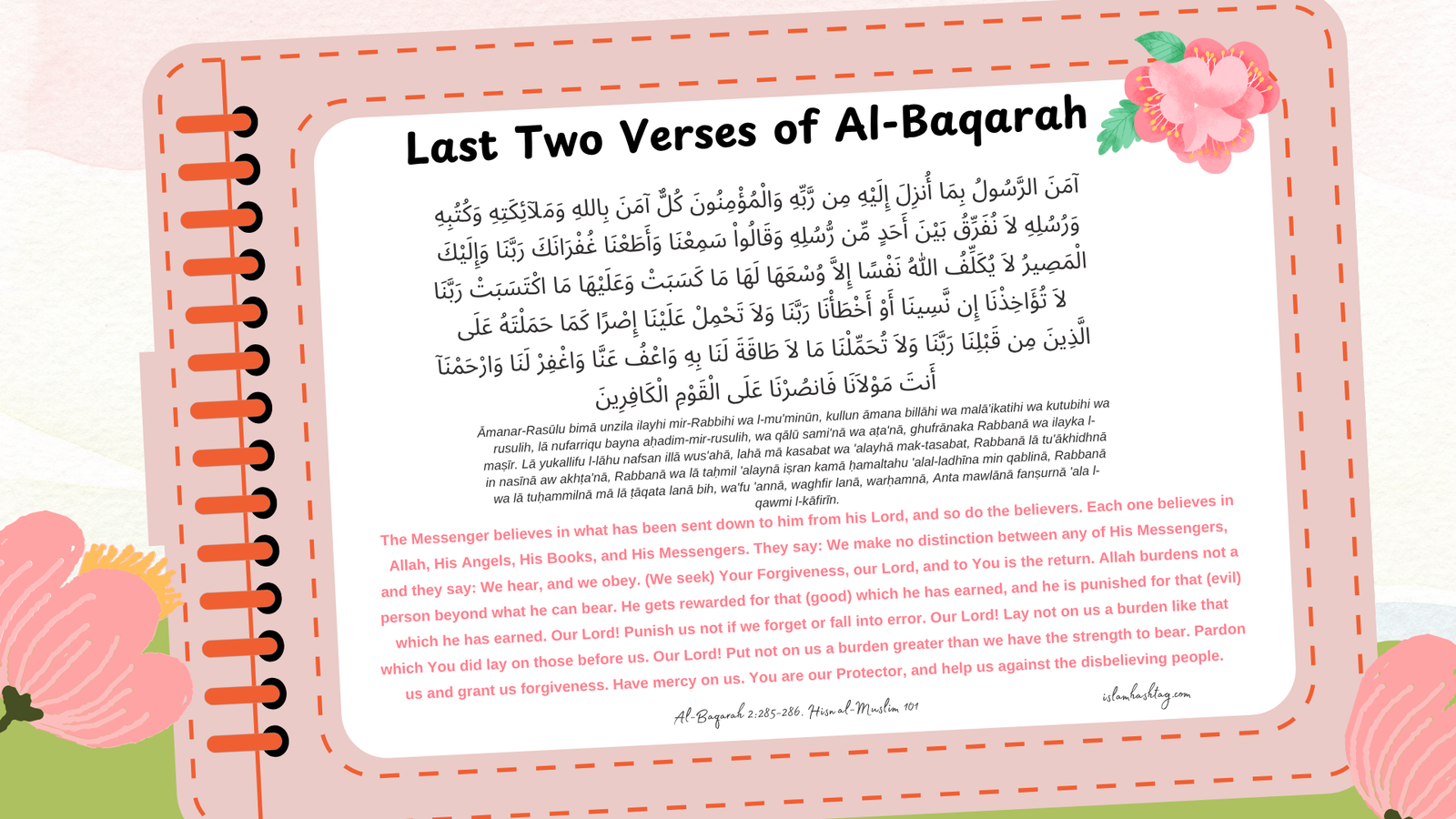
Aamanar-Rasoolu bimaaa unzila ilaihi mir-Rabbihee walmu’minoon; kullun aamana billaahi wa Malaaa’ikathihee wa Kutubhihee wa Rusulihee laa nufarriqu baina ahadim-mir-Rusulih wa qaaloo sami’naa wa ata’naa ghufraanaka Rabbanaa wa ilaikal-maseer
Laa yukalliful-laahu nafsan illaa wus’ahaa; lahaa maa kasabat wa ‘alaihaa maktasabat; Rabbanaa laa tu’aakhiznaaa in naseenaaa aw akhtaanaa; Rabbanaa wa laa tahmil-‘alainaaa isran kamaa hamaltahoo ‘alal-lazeena min qablinaa; Rabbanaa wa laa tuhammilnaa maa laa taaqata lanaa bih; wa’fu ‘annaa waghfir lanaa warhamnaa; Anta mawlaanaa fansurnaa ‘alal qawmil kaafireen
The last two verses of Surah Al-Baqarah — verses 285 and 286 — are among the most frequently recited and memorized passages in the entire Quran, largely due to a specific, well-known hadith describing their protective virtue when read at night.

The first of these verses, 285, affirms belief in the core articles of faith: “The Messenger has believed in what was revealed to him from his Lord, and [so have] the believers. All of them have believed in Allah and His angels and His books and His messengers… We hear and we obey. [We seek] Your forgiveness, our Lord, and to You is the [final] destination.” It functions almost as a summary declaration of faith, affirming belief in Allah, the angels, the revealed scriptures, and the messengers.
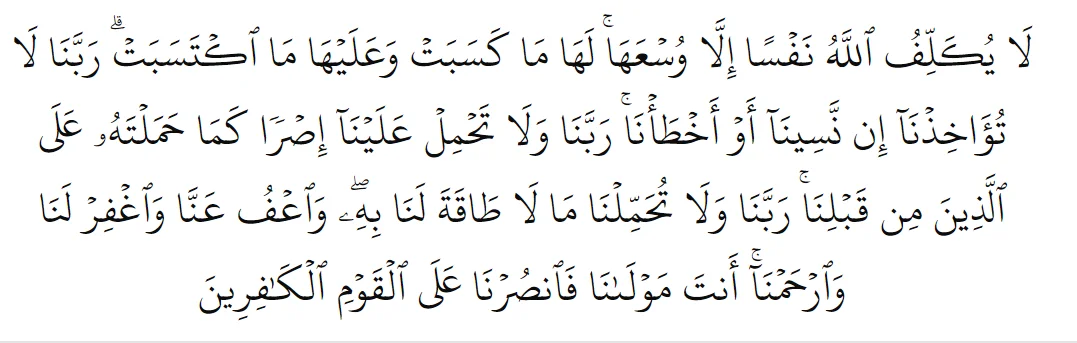
The second verse, 286, shifts tone toward comfort and reassurance: “Allah does not charge a soul except [with that within] its capacity… Our Lord, do not impose blame upon us if we forget or make a mistake… and forgive us, and pardon us, and have mercy upon us.” This verse is often highlighted for its reassurance that Allah does not burden anyone beyond what they can bear, followed by a series of direct supplications asking for forgiveness for mistakes, relief from difficult burdens, and mercy — making it as much a comprehensive dua as it is a statement of belief.
Surah Baqarah Last 2 Ayat virtue
The specific virtue attached to these two verses comes from an authentic hadith in which the Prophet Muhammad, peace be upon him, said: “Whoever recites the last two verses of Surah Al-Baqarah at night, they will be sufficient for him.” Scholars have offered a few interpretations of what “sufficient” means here, with the most common understanding being protection from harm through the night, along with the reward equivalent to standing in prayer for part of the night — though scholars caution against treating this narrowly as a guaranteed formula rather than an act of worship whose benefit ultimately comes from Allah.
Because of this hadith, many Muslims incorporate these two verses into their nightly routine before sleeping, often alongside other recommended night-time adhkar (remembrances) such as Ayat al-Kursi and the last three short surahs of the Quran (Al-Ikhlas, Al-Falaq, and An-Nas). Together, these form a common bedtime recitation practice aimed at seeking protection through the night.
Beyond their nighttime recitation, these verses are also commonly studied for their theological content, since verse 285 offers one of the Quran’s clearest, most concise statements of the core pillars of faith (iman) — belief in Allah, angels, books, and messengers — while verse 286 addresses questions many people naturally have about divine justice and human capability, affirming that no one is asked to do more than they’re able.
For memorization students, these two verses are often taught early, both because of their manageable length relative to the rest of the lengthy Surah Al-Baqarah, and because of the practical, daily habit of reciting them each night — a habit that naturally reinforces memorization through repetition far more effectively than isolated study sessions alone.
For anyone building a nightly routine around these verses, reciting them slowly with attention to their meaning — rather than rushing through them purely out of habit — is generally encouraged by scholars, since the comfort and reassurance found in verse 286 in particular is meant to be reflected on, not just recited mechanically before falling asleep.