
Once lying down, the Prophet ﷺ taught a second, distinct supplication before actually falling asleep — recorded in Sahih Muslim and the Musnad of Imam Ahmad — that addresses Allah ﷻ directly as the Creator and Reclaimer of the soul.
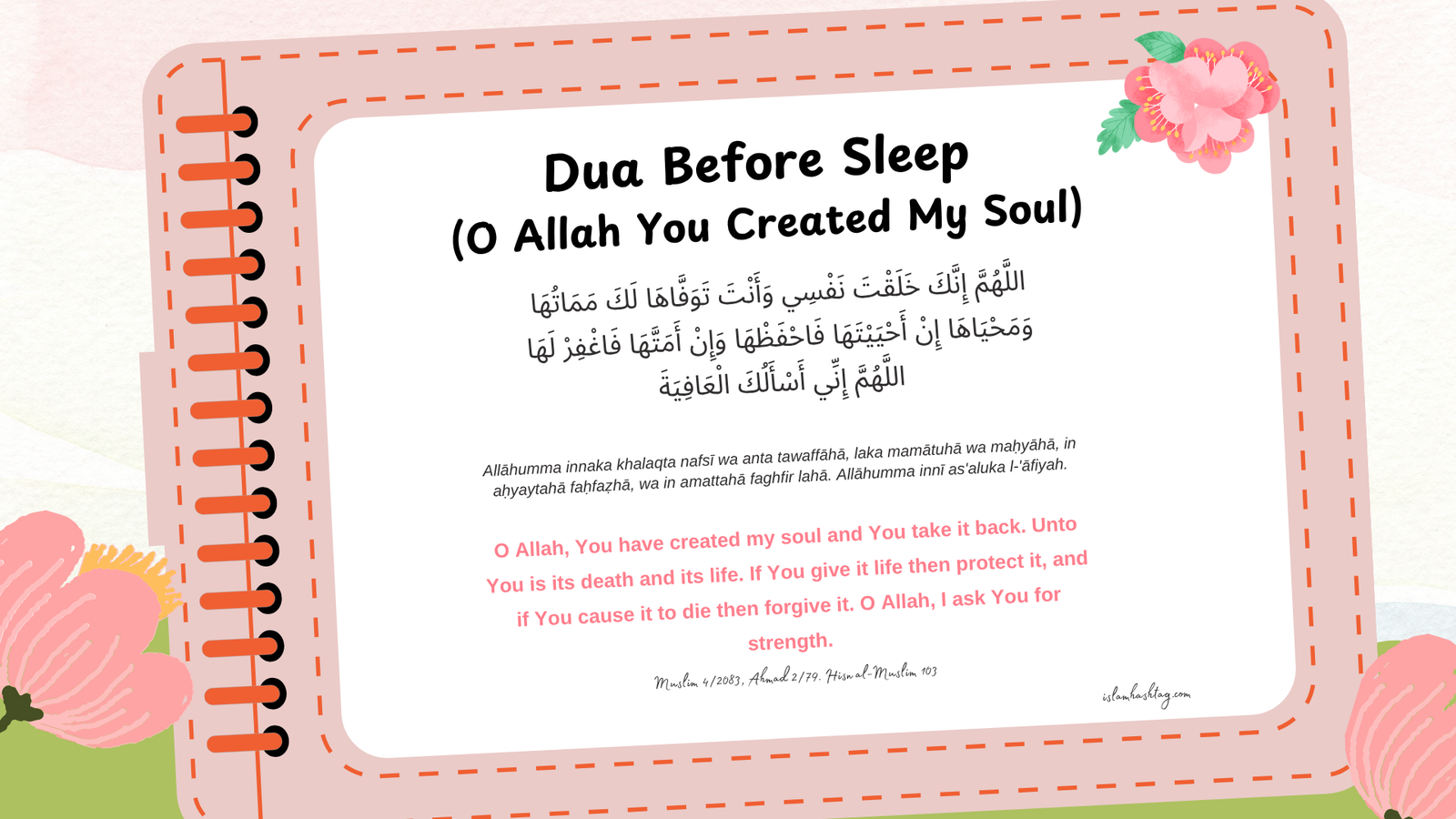
Arabic:
اللَّهُمَّ إِنَّكَ خَلَقْتَ نَفْسِي وَأَنْتَ تَوَفَّاهَا لَكَ مَمَاتُهَا وَمَحْيَاهَا إِنْ أَحْيَيْتَهَا فَاحْفَظْهَا وَإِنْ أَمَتَّهَا فَاغْفِرْ لَهَا اللَّهُمَّ إِنِّي أَسْأَلُكَ الْعَافِيَةَ
Transliteration: Allāhumma innaka khalaqta nafsī wa anta tawaffāhā, laka mamātuhā wa maḥyāhā, in aḥyaytahā faḥfaẓhā, wa in amattahā faghfir lahā. Allāhumma innī as’aluka l-‘āfiyah.
Translation: “O Allah, You have created my soul and You take it back. Unto You is its death and its life. If You give it life then protect it, and if You cause it to die then forgive it. O Allah, I ask You for strength (well-being).”
Reference: Sahih Muslim 4/2083; Musnad Ahmad 2/79; Hisn al-Muslim 103.
This dua is structurally close to the one recited when lying down, but it goes further: it names Allah ﷻ explicitly as both Khāliq (Creator) of the soul and the One who takes it back, and it closes with a direct request for al-‘āfiyah — a comprehensive term scholars translate as wellness, strength, and safety from both worldly and spiritual harm, not merely physical health.
Sleep researchers and Islamic scholars alike have noted the psychological function of such a practice: ending the day by verbally surrendering the uncertainty of whether one will wake again removes it as a source of anxiety rather than suppressing it. This dua is best recited immediately after “Bismika Rabbī waḍa’tu janbī,” forming a short but complete sequence the Prophet ﷺ modeled every night before sleep, regardless of how busy or difficult the day had been. Together, the two form the core of the Sunnah bedtime routine, easily memorized in a single sitting.