
Dua for Wearing clothes: A Short Sunnah for Every Day
Getting dressed is one of the most repeated actions in daily life, and the Prophet ﷺ attached a brief dua to it — narrated across five of the major hadith collections, making it among the most widely authenticated of the daily-life adhkar.
Arabic:
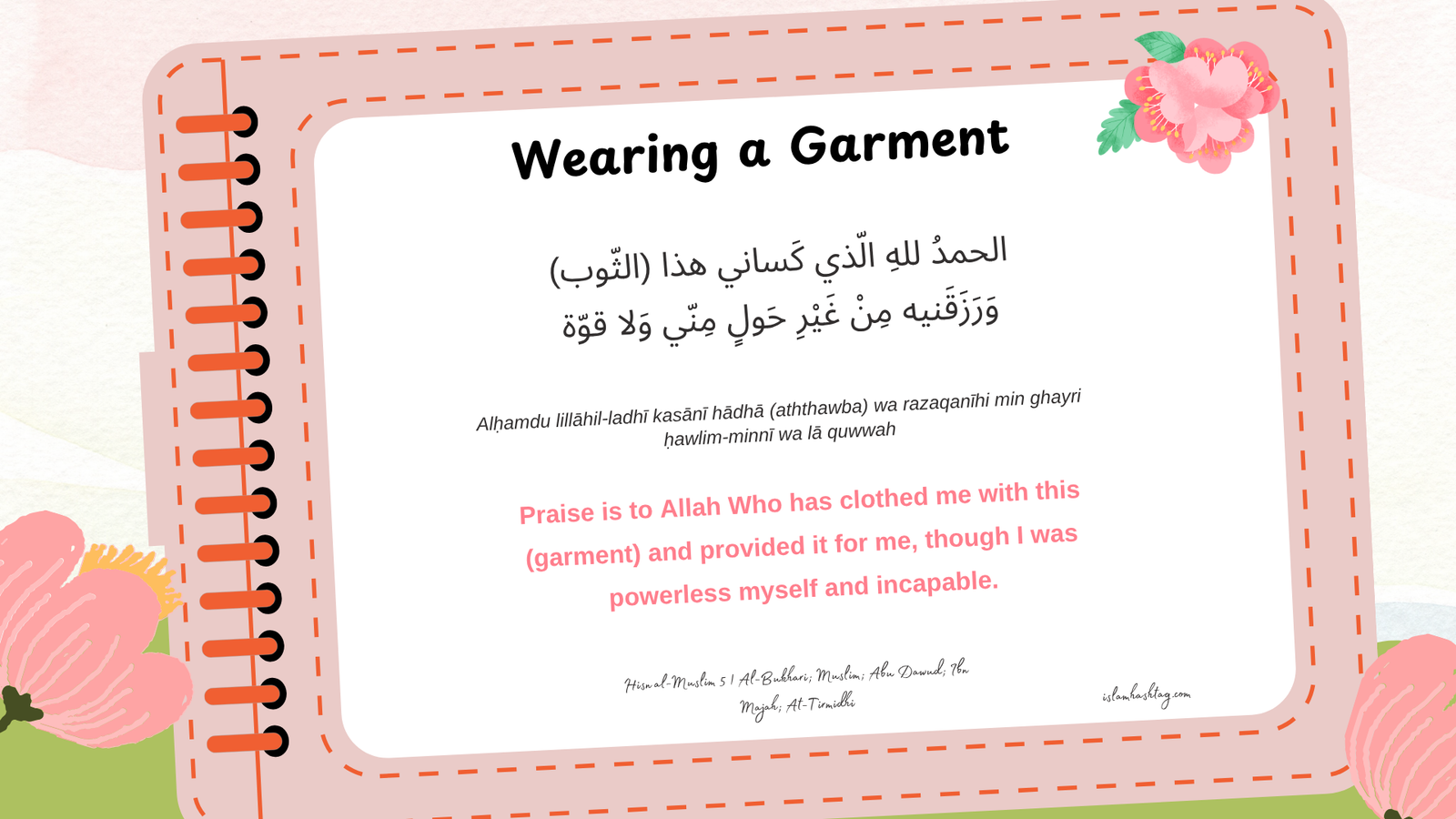
الحمدُ للهِ الّذي كَساني هذا (الثّوب) وَرَزَقَنيه مِنْ غَيْرِ حَولٍ مِنّي وَلا قوّة
Transliteration: Alḥamdu lillāhil-ladhī kasānī hādhā (aththawba) wa razaqanīhi min ghayri ḥawlim-minnī wa lā quwwah.
Translation: “Praise is to Allah Who has clothed me with this (garment) and provided it for me, though I was powerless myself and incapable.”
Reference: Hisn al-Muslim 5; narrated in Sahih al-Bukhari’s chapters on supplication, Sahih Muslim, Sunan Abu Dawud, Sunan Ibn Majah, and Jami’ at-Tirmidhi.
The phrase “min ghayri ḥawlim-minnī wa lā quwwah” — “though I was powerless myself and incapable” — is the theological center of this short dua. It acknowledges that even something as basic as having clothing to wear was not secured by one’s own effort alone; the cotton, the labor, the ability to purchase and put it on are all treated as provision (rizq) from Allah ﷻ rather than a given.
Scholars note that this dua can be recited for any garment — daily clothing, not only special occasions — which is part of why it is recorded across so many collections: it reflects an ordinary, repeated moment of the day rather than a rare event. Reciting it consistently trains the habit of locating gratitude inside routine actions rather than reserving thankfulness for major blessings alone. It pairs naturally with the separate, longer dua specifically reserved for new garments, and together the two cover nearly every occasion involving what one wears.
Distinct from the short dua recited for any garment, the Prophet ﷺ taught a longer, separate supplication specifically for new clothing — narrated in Sunan Abu Dawud and Jami’ at-Tirmidhi, and referenced in Al-Albani’s Mukhtasar Shama’il at-Tirmidhi.
Arabic:
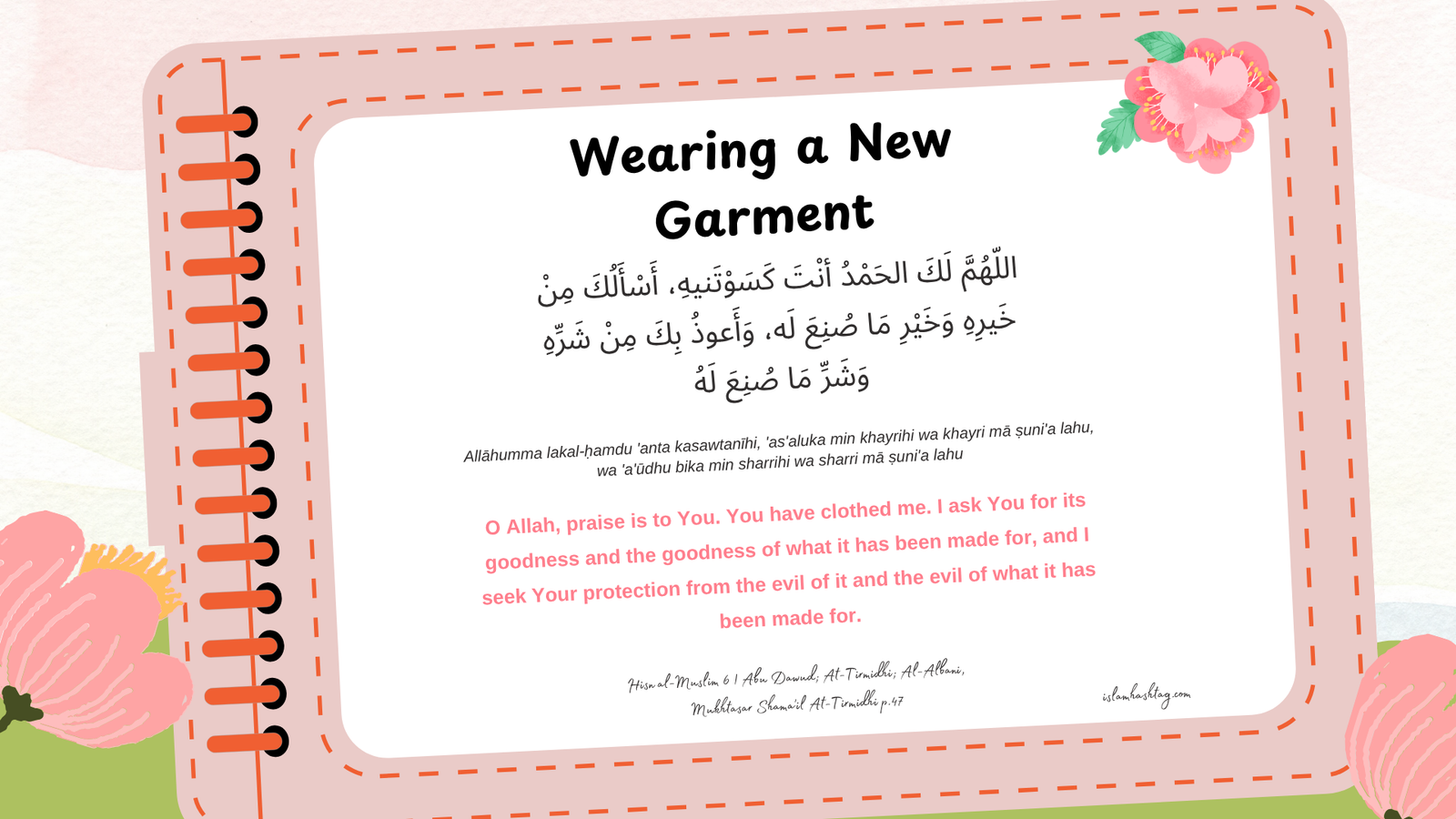
اللّهُمَّ لَكَ الحَمْدُ أنْتَ كَسَوْتَنيهِ، أَسْأَلُكَ مِنْ خَيرِهِ وَخَيْرِ مَا صُنِعَ لَه، وَأَعوذُ بِكَ مِنْ شَرِّهِ وَشَرِّ مَا صُنِعَ لَهُ
Transliteration: Allāhumma lakal-ḥamdu ‘anta kasawtanīhi, ‘as’aluka min khayrihi wa khayri mā ṣuni’a lahu, wa ‘a’ūdhu bika min sharrihi wa sharri mā ṣuni’a lahu.
Translation: “O Allah, praise is to You. You have clothed me. I ask You for its goodness and the goodness of what it has been made for, and I seek Your protection from the evil of it and the evil of what it has been made for.”
Reference: Hisn al-Muslim 6; Sunan Abu Dawud; Jami’ at-Tirmidhi; Al-Albani, Mukhtasar Shama’il at-Tirmidhi, p.47.
The key difference from the everyday clothing dua is the phrase “khayri mā ṣuni’a lahu” — “the goodness of what it has been made for.” Rather than only thanking Allah ﷻ for the garment itself, this dua asks for blessing in its purpose: if it is a garment for work, for a wedding, for travel, the du’a extends to the occasion the clothing will be worn for, and seeks protection from any harm connected to that purpose as well.
Some narrations additionally mention the Companions removing the old garment and giving it in charity when a new one was acquired — though this specific practice is reported with a weaker chain than the dua itself, and scholars differ on whether it was a general habit of the Prophet ﷺ or specific to certain occasions. The dua’s authenticity, by contrast, is well established, and it is worth memorizing alongside the everyday clothing dua so that both are ready whenever needed — one for daily wear, one reserved for what is new.