
What Is a Digital Tasbih? The Complete Guide to Digital Dhikr Counters
Every day, millions of Muslims reach for a tasbih to count their dhikr — the repeated remembrance of Allah through phrases like SubhanAllah, Alhamdulillah, and Allahu Akbar. Traditionally, this meant a string of 33 or 99 beads. Today, more and more Muslims are switching to a digital tasbih — a modern tool that makes counting dhikr easier, more accurate, and easier to track over time.
We also live in a time where almost everyone — adults and children alike — is constantly tapping on their phones. Social media, games, and endless scrolling have become part of daily life, and many of us find ourselves addicted to the screen. But what if every tap could become something meaningful? What if, instead of empty swipes and clicks, each touch on the screen filled our scales of good deeds? That’s exactly what a digital tasbih makes possible — turning a habit we already have into something that benefits our Ākhirah instead of distracting us from it.
If you’ve searched for “digital tasbih” and want to understand exactly what it is, how it works, and which option is right for you, this guide covers everything.
What Is a Digital Tasbih?
A digital tasbih (also written as “tasbih digital” or called a digital tasbih counter) is an electronic or software-based device used to count dhikr instead of the traditional string of prayer beads. Instead of moving a bead with your finger for each repetition, you press a button — physical or on-screen — and a number increases automatically.
Digital tasbih counters come in a few forms:
- Handheld electronic counters — small clicker-style devices, sometimes shaped like a ring, with a button and a digital display
- Tasbih counter rings — wearable digital counters worn on the finger, often with an LED or small screen
- Mobile apps — dhikr counter apps installed on a smartphone
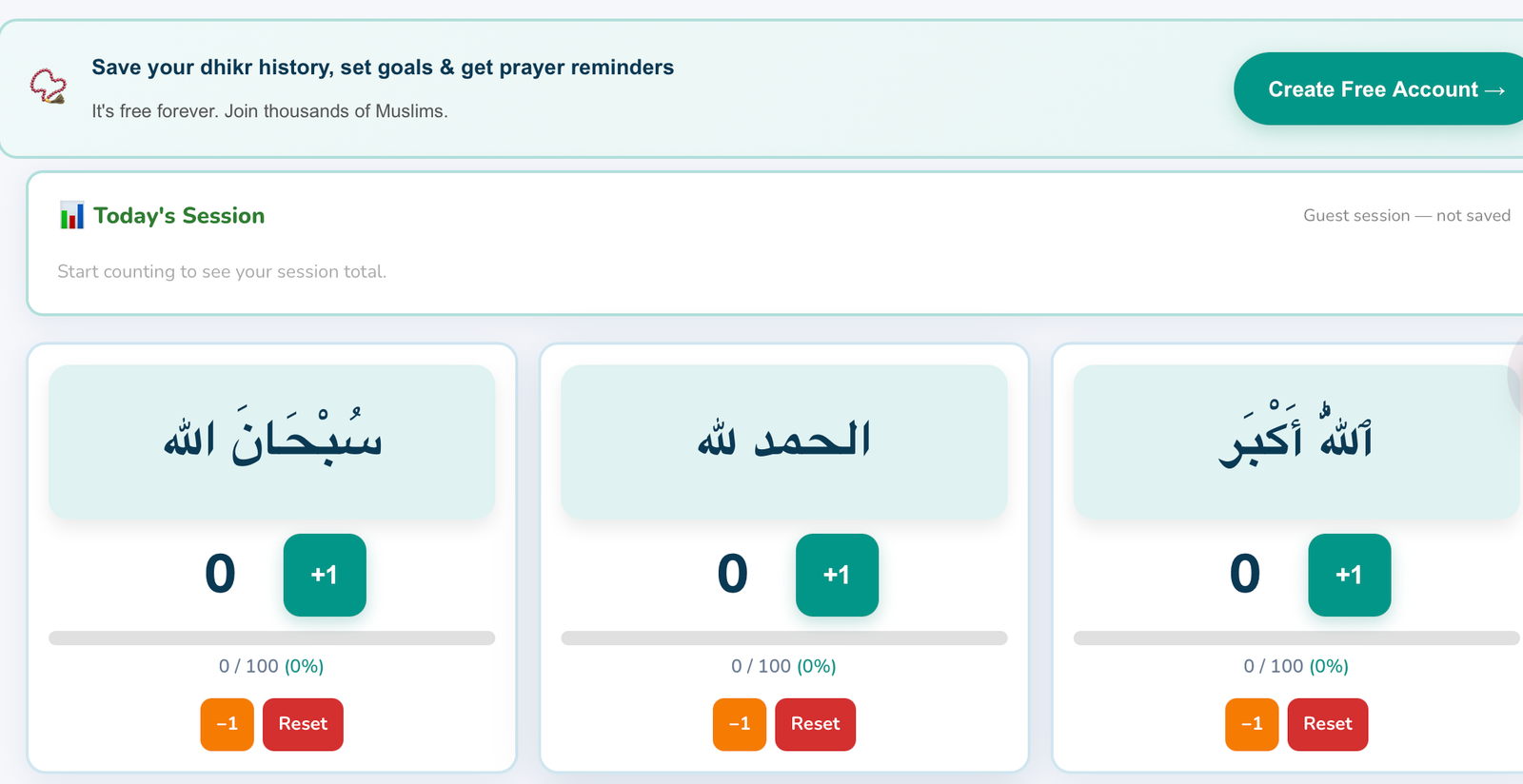
- Online/web-based tasbih counters — browser tools you can use instantly with no download, like the one on this page
Whichever form it takes, the purpose is the same: to give you an accurate, effortless count of your dhikr so you can focus on the remembrance itself rather than losing track of numbers — and, for children especially, to turn the habit of tapping a screen into a spiritual habit instead of an idle one.
Why Use a Digital Tasbih Instead of Traditional Beads?
Traditional tasbih beads are beautiful and deeply rooted in Islamic tradition, and many people will always prefer them. But a digital tasbih counter solves a few real problems:
1. You never lose your place. With beads, if you’re interrupted mid-dhikr, it’s easy to forget your count. A digital counter holds the number for you.
2. It tracks your history. Good digital tasbih tools (like online counters with an account) save your daily, monthly, and yearly dhikr totals automatically, so you can see your progress over weeks and months — something beads simply can’t do.
3. It’s always with you. Your phone or a small clicker fits in a pocket. Many people find it easier to count dhikr while walking, commuting, or waiting somewhere, without needing to carry beads.
4. You can count higher, more easily. For dhikr that isn’t limited to 33 or 99 (such as istighfar during a specific time or a personal goal), a digital counter lets you set custom targets and track them precisely.
5. Multiple dhikr, one tool. Instead of switching beads or losing count between different adhkar (Subhanallah, Alhamdulillah, Allahu Akbar, Astaghfirullah, and more), a digital tasbih counter can track each one separately, at the same time.
How to Use a Digital Tasbih
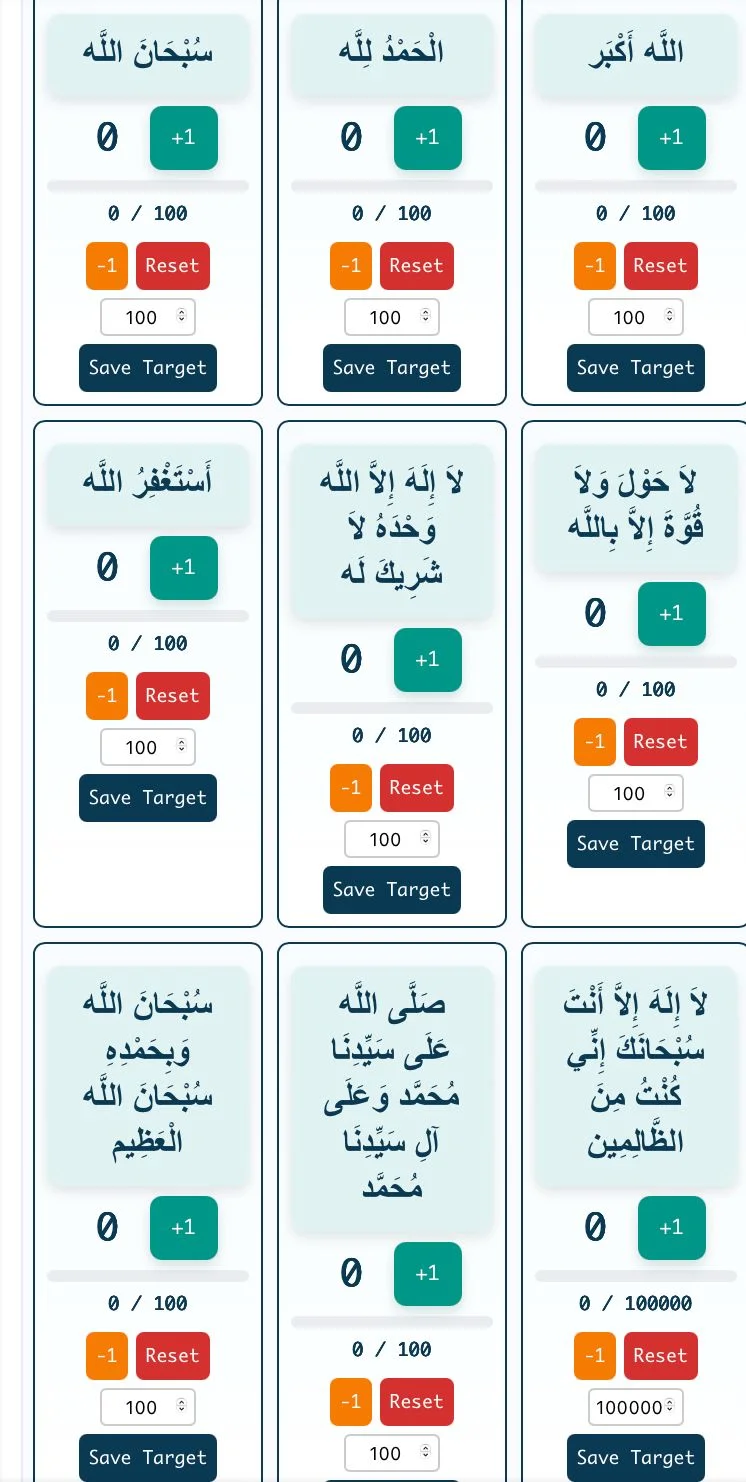
Using a digital tasbih is simple, whether it’s a physical clicker or an online tool. On Islam Hashtag’s Digital Tasbih & Dhikr Counter, the process looks like this:
- Register and create your account — your dhikr log is tied to your account, so every tasbih you do is saved securely.
- Choose your dhikr and set a target — for example, 100 “SubhanAllah” daily — and work towards completing it.
- Press +1 for every repetition. On a physical device this is a button; on an online tasbih counter it’s usually a large, tap-friendly button on the screen.
- Track your progress through daily, monthly, and yearly reports. If you notice your dhikr was less than the previous day, let that motivate you to increase it the next day.
- Build healthy competition. Compare your dhikr log with friends, classmates, or family members — a healthy competition in goodness, racing towards the pleasure of Allah. As Allah says in the Qur’an:﴿فَاسْتَبِقُوا الْخَيْرَاتِ﴾ “So race to [all that is] good.” (Qur’an 2:148)And the Prophet ﷺ taught that the believer who strives, seeks Allah’s help, and doesn’t lose heart is more beloved to Allah than one who doesn’t strive — while good remains in both (Muslim).
- Build consistency. By logging in daily, setting goals, and reviewing your reports, you slowly build a lasting habit of dhikr that grows with you and your family.
That’s the entire process — no learning curve, and it works whether you’re praying at home, sitting after Fajr, or doing dhikr while out and about.
What Is a Digital Tasbih Counter (in More Detail)?
A digital tasbih counter specifically refers to the counting mechanism itself — the part of the device or app responsible for tracking your number. Some digital tasbih counters are extremely basic: a single button and a display showing one number. Others, especially LED tasbih counters and app-based tools, are far more advanced, letting you:
- Track several different adhkar side by side, each with its own running total
- Set a daily goal (e.g., 100 istighfar per day) and see your progress as a percentage
- View your history across days, weeks, months, and even years
- Get reminders to continue your dhikr practice
- See a leaderboard or family/friends comparison to stay motivated
If you’ve come across the term “tasbih digital LED zikir counter,” this usually refers to a small handheld or clip-on electronic device with an LED number display — a popular gadget in markets across South Asia, Southeast Asia, and the Middle East for exactly this reason.
An Islamic Productive Tool for Families
A tasbih has always been a personal act of worship — but dhikr is also something a family can build together, and this is where a digital tasbih counter has an advantage no string of beads can offer.
Turn screen time into a shared good deed. Instead of parents worrying about how much time their children spend tapping on a phone, a digital tasbih gives that habit a purpose. A child tapping “SubhanAllah” a hundred times is a child whose fingers are being trained toward the remembrance of Allah instead of a game.
Set family goals together. Parents can decide on a daily dhikr target for the household — for example, everyone completing 100 “Alhamdulillah” after Fajr — with each family member logging it individually. Seeing everyone’s progress side by side turns a private act of worship into a shared family habit.
Model consistency for your children. Children learn dhikr far more effectively by watching their parents do it than by being told to. When a child sees a parent open their tasbih counter after every prayer, that example plants a habit that can last a lifetime.
Create healthy competition between siblings. The same instinct that drives children to compare high scores in a game can be redirected toward the Ākhirah — siblings racing each other to complete their daily tasbih, or cousins comparing their Ramadan dhikr totals.
Fit worship into busy family life. Between school runs, work, and household routines, formal gatherings for dhikr aren’t always possible. A tool every family member can open individually and track over weeks and months makes consistency realistic, even on the busiest days.
Rewards of Each Dhikr
The phrases tracked by a digital tasbih aren’t just any words — they carry some of the greatest rewards mentioned in the Qur’an and Sunnah. A few examples:
SubhanAllah wa bihamdihi The Prophet ﷺ taught that two phrases are light on the tongue, extremely heavy on the scale of good deeds, and beloved to the Most Merciful: Subhan Allahi wa bihamdihi, Subhan Allahil-‘Azim (Bukhari and Muslim). He also said that whoever repeats Subhan Allahi wa bihamdihi one hundred times in a day will have their sins forgiven, even if they are as abundant as the foam of the sea (Bukhari and Muslim).
La ilaha illallah, wahdahu la sharika lah The Prophet ﷺ said that whoever repeats this declaration one hundred times in a day receives a reward equal to freeing ten slaves, has one hundred good deeds recorded, has one hundred bad deeds erased, and is protected from Shaytan for that day until evening (Bukhari and Muslim).
SubhanAllah, Alhamdulillah, Allahu Akbar (33 times each after prayer) The Prophet ﷺ taught his daughter Fatimah (may Allah be pleased with her) to say SubhanAllah 33 times, Alhamdulillah 33 times, and Allahu Akbar 34 times after every prayer, telling her this was better for her than a servant to help with her housework (Bukhari).
Istighfar (seeking forgiveness) The Prophet ﷺ himself would seek Allah’s forgiveness more than seventy times a day, despite being free of sin — showing the weight of this dhikr for the rest of us (Bukhari).
Salawat upon the Prophet ﷺ Sending salutations upon the Prophet ﷺ even once causes Allah to send ten blessings upon the one who says it (Muslim) — one of the simplest deeds with one of the largest, most immediate rewards.
Every tap on a digital tasbih, then, is not a small thing. Multiplied across a day, a month, and a year, these simple phrases — logged one click at a time — can become one of the heaviest and most beloved sections of a believer’s record with Allah.
Where to Buy a Digital Tasbih (Physical Devices)
If you specifically want a handheld electronic tasbih counter or a tasbih counter ring, these are widely available:
- Local Islamic bookstores and gift shops, especially near mosques
- General marketplaces (search for “digital tasbih counter” or “tasbih counter ring”)
- Electronics and gadget stores in regions like South Asia and the Gulf, where LED zikir counters are common
Prices are usually low, but quality varies — buttons can wear out, batteries need replacing, and the count resets if the device runs out of power at the wrong moment.
Or, Skip the Hardware: Use an Online Digital Tasbih Counter for Free
If you’d rather not deal with buying, charging, or losing a physical device, an online digital tasbih counter gives you all the same benefits with none of the downsides — plus the daily, monthly, and yearly tracking a basic clicker can’t offer.
Islam Hashtag’s free Digital Tasbih & Dhikr Counter lets you:
- Count multiple adhkar at once — SubhanAllah, Alhamdulillah, Allahu Akbar, Astaghfirullah, Salawat, and more — each with its own tally
- Set a target for each dhikr (33, 99, 100, or any custom number) and see your progress
- Create a free account to save your dhikr history permanently, so your counts carry over from session to session, day to day, and year to year
- Compare your progress with family and friends for healthy competition in good deeds
- Use it directly in your browser — no app download required
It’s built specifically for people — and families — who want the reliability of a digital tasbih counter with the added benefit of a long-term dhikr record, something a basic handheld clicker can’t offer.
Try the free Digital Tasbih Counter →
Common Questions About Digital Tasbih
What is digital tasbih? It’s a tool — physical or digital — that counts your dhikr repetitions automatically, replacing the traditional method of counting on prayer beads.
Is using a digital tasbih instead of beads permissible? Yes. The purpose of a tasbih, whether beads or a counter, is simply to help you keep track of your dhikr — it’s a tool, not an act of worship in itself. Any method of counting dhikr accurately, including fingers, beads, or digital counters, is acceptable, since the value lies in the remembrance of Allah itself.
What is a tasbih digital LED zikir counter? It’s a small electronic device, often worn like a ring or held like a clicker, with an LED display that shows your current dhikr count.
Can I track more than one dhikr at once? With a basic single-button clicker, no — you’d need to reset it each time. With an app or online tasbih counter like Islam Hashtag’s, yes — you can track SubhanAllah, Alhamdulillah, Allahu Akbar, and others simultaneously.
Do I need to create an account to use an online digital tasbih? Creating a free account allows your dhikr history to be saved permanently — daily, monthly, and yearly — instead of resetting when you close the page, and lets you compare progress with family members.
Is this suitable for children? Yes — in fact, children who are already drawn to tapping and clicking on screens often take to it quickly, since it turns a habit they already have into a spiritual one, with parents able to set goals and watch progress together as a family.
Start Counting Your Dhikr Today

Whether you choose a handheld electronic clicker, a tasbih counter ring, or a browser-based tool, a digital tasbih makes it effortless to stay consistent with your daily adhkar — for you, and for your whole family. If you want a free option that keeps a permanent record of your progress and lets every click count for your Ākhirah, start right away with the Islam Hashtag Digital Tasbih Counter — no download, no cost, just open it and begin.