
Dua before entering the bathroom and Dua after Leaving the bathroom
بِسْمِ اللَّهِ الرَّحْمَٰنِ الرَّحِيمِ
Of all the daily adhkar the Prophet ﷺ taught his companions, the two attached to using the bathroom are among the most consistently practiced by Muslims worldwide — likely because the need arises multiple times a day, giving the practice more repetition than almost any other Sunnah. Yet many who say these words were never taught why — the specific protection they invoke, and the reasoning classical scholars gave for each one.

Before Entering the Bathroom
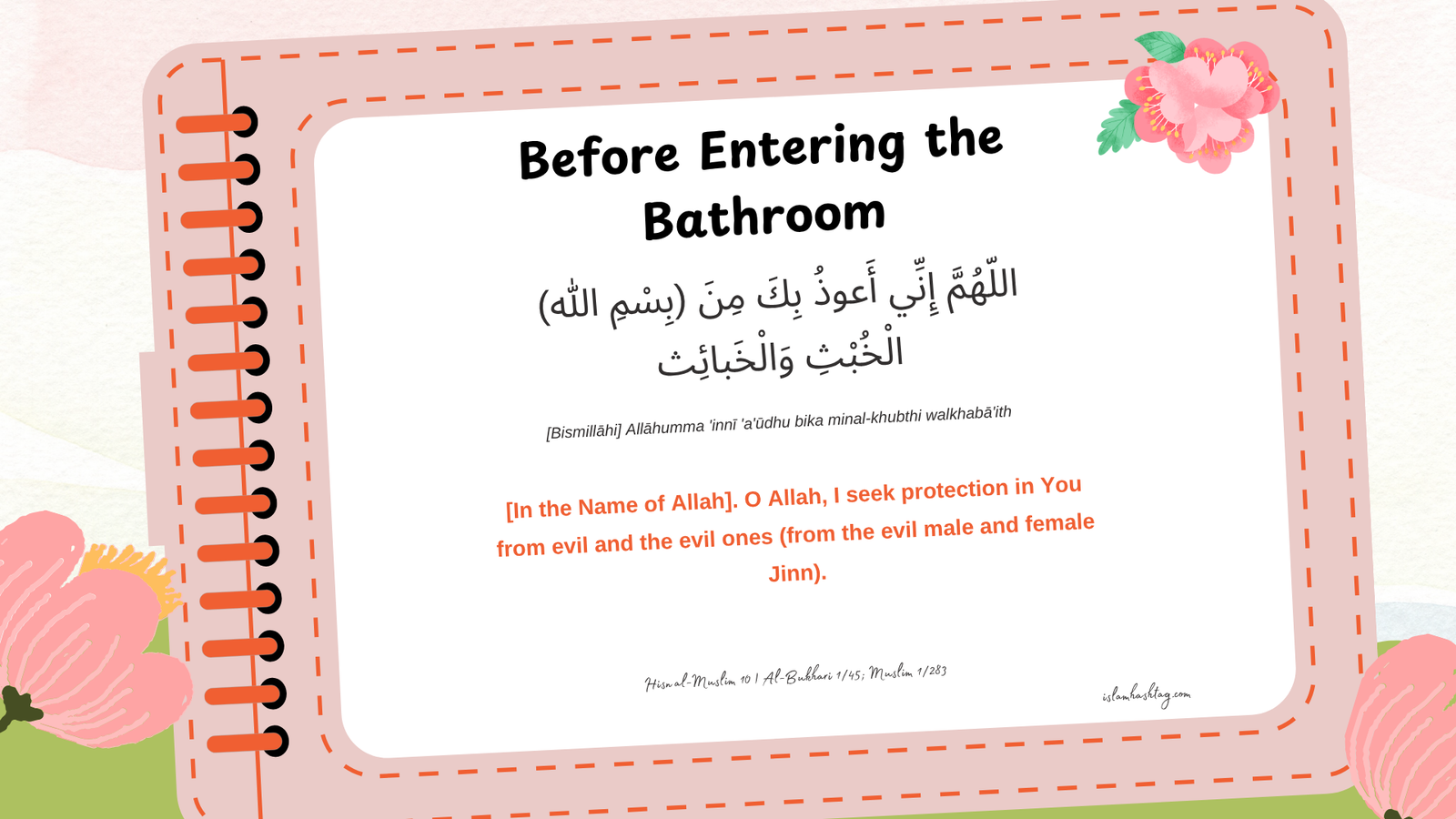
Arabic: (بِسْمِ الله) اللّهُمَّ إِنِّي أَعوذُ بِكَ مِنَ الْخُبْثِ وَالْخَبائِث
Transliteration: [Bismillāhi] Allāhumma ‘innī ‘a’ūdhu bika minal-khubthi walkhabā’ith
Translation: “[In the Name of Allah]. O Allah, I seek protection in You from evil and the evil ones (from the evil male and female jinn).”
Reference: Hisn al-Muslim 10; Sahih al-Bukhari 1/45; Sahih Muslim 1/283.
This dua is recorded in both Sahih al-Bukhari and Sahih Muslim — the two most rigorously authenticated hadith collections — making it among the most firmly established of all the daily-life adhkar. Al-khubth and al-khaba’ith are understood by the majority of hadith commentators, including An-Nawawi in his commentary on Sahih Muslim, to refer to male and female jinn specifically, since bathrooms and similarly unclean or secluded places were traditionally understood as places where such beings are present. The dua is therefore not a general statement of disgust at uncleanliness, but a specific request for protection from unseen harm in a place where a person is physically vulnerable and their ‘awrah exposed.
Some scholars additionally note that where the Bismillah portion is combined with this dua, it should ideally be said before removing any clothing — connecting this practice back to the general instruction to say Bismillah before undressing covered elsewhere in this series.
After Leaving the Bathroom

Arabic: غُفْرانَك
Transliteration: Ghufrānaka
Translation: “I seek Your forgiveness.”
Reference: Hisn al-Muslim 11; narrated in Sunan Abu Dawud, Sunan Ibn Majah, Jami’ at-Tirmidhi, and Sunan an-Nasa’i.
This one-word dua — narrated by A’ishah (RA), who reported that the Prophet ﷺ would say it upon leaving the bathroom — has drawn genuine scholarly discussion about why forgiveness is sought after an act that involves no sin. Several explanations are offered in the classical commentary literature: some scholars suggest it reflects gratitude for the ease of relieving oneself, given that withholding this ability would itself be a punishment, and seeking forgiveness for having been unable to remember and praise Allah ﷻ continuously while occupied with a bodily need in an unclean place. Ibn al-Qayyim discusses this dua in his work on Prophetic guidance (Zad al-Ma’ad), framing it as an example of the Prophet’s ﷺ constant orientation toward gratitude and repentance even in the most physically mundane moments of the day.
Reflection: Even the most private and physically ordinary moments of the day are, in the Sunnah, treated as occasions for the remembrance of Allah ﷻ — a reminder that no part of a believer’s life sits outside His care.
References cited: Hisn al-Muslim 10, 11; Sahih al-Bukhari 1/45; Sahih Muslim 1/283; Sunan Abu Dawud; Sunan Ibn Majah; Jami’ at-Tirmidhi; Sunan an-Nasa’i.
📌 You might also like:
– Dua for Wearing a Garment
– Dua for New Clothes and Undressing
– Dua When Lying Down to Sleep