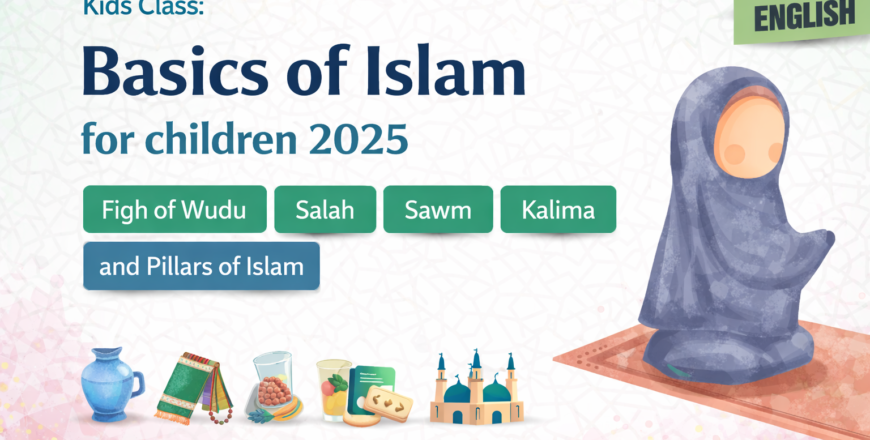
Basics of Islam for children 2025

- Description
- Grade
Basics of Islam for kids 2025
As parents, we want our children to grow up knowing who Allah is, why we worship Him, and how to live Islam with confidence and ease. We want their practice to be correct, their understanding to be clear, and their relationship with Islam to be loving—not rushed or overwhelming.
The Basics of Islam for Kids course is designed with this intention.
This course introduces children to the foundations of Islamic belief and practice, helping them understand the “why” behind what they do—why we make wudu, why we pray, why we fast, and how these acts bring us closer to Allah. The lessons are taught gently, using clear English explanations, so children can follow comfortably and ask questions without hesitation.
Rather than treating Islamic rulings as rules to memorise, the course helps children see them as acts of worship filled with meaning, care, and wisdom.
What Your Child Will Learn
Through structured and age-appropriate lessons, your child will learn:
Knowing Allah and understanding the purpose of our creation
Why we desire Jannah and how our actions lead us towards it
The virtue of cleanliness in Islam
The importance and virtues of wudu
How to perform wudu correctly
Actions that break wudu
Ghusl and tayammum, explained simply
Prayer times and rak‘ahs of salah
How to pray 2, 3, and 4 rak‘ah salah
The Kalimah and its meaning
The Pillars of Islam
Sawm: why we fast and what breaks the fast
An introduction to zakat
Sunnahs and etiquettes of using the restroom
Sunnahs and etiquettes of eating
Etiquettes of changing clothes
Islamic manners with friends
Respecting parents and teachers
These lessons help children build both correct practice and good character, allowing Islam to naturally become part of their daily life.
Who Is This Course For
Children aged 7–14 years
Medium of instruction: English explanation
About the Teacher
The course is taught by Ustadha Fahmina Jawed, who has studied Alamiyyah Hanafi Fiqh from two prestigious Islamic institutes and has undergone extensive classical Islamic training under eminent scholars.
Her studies include core Islamic sciences and key classical texts such as Tafsir of the Quran, Riyadh as-Saliheen, Mishkat al-Masabih, Bukhari Sharif, Tirmidhi Sharif, Muslim Sharif, Abu Dawud Sharif, and more. Her teaching approach combines traditional scholarship with a deep understanding of how children learn, ensuring clarity without confusion and firmness without pressure.
-
1
 Class Link
 -
2
 Introduction
 -
3
 Class 01- Jannah: Our Inspiration
 -
4Excercise 1
-
5Class 02- 6 Articles of Faith
-
6Angels in Islam Activity
-
76 Articles of Faith Activity
-
8Class 03- 5 Pillars of Islam introduction
-
95 Pillars of Islam Activity
-
10Class 04-Wudu 1
-
11Classwork
-
12Class 05-wudu 2
-
13Classwork
-
14Ghusl Notes
-
15Tayyamum Notes
-
16Salah 01
-
17Activity
-
18Salah 02
-
19Salah 03
-
20Difference in posture of Salah of Women
-
21Activity- Find the Words
-
22Salah 04
-
23Salah 05
-
24Sawm 1
-
25Sawm 2
-
26Sawm Quiz
-
27Sawm Quiz 2
-
28Types of charity
-
29Zakat