
Best Summer Arabic Course on Arabic numbers: Closing the One Gap Most Curricula Skip
If you’ve completed your Alimiyyah , you already know Arabic grammar isn’t your weak point. You’ve worked through Nahw and Sarf, you can parse a sentence from the Quran or a hadith text, and you’re comfortable with i’rab in most contexts. So why do Arabic numbers still trip you up?
It’s one of the strangest gaps in Arabic pedagogy: students graduate with strong command of verb conjugation, case theory, and sentence structure, yet numbers — something that feels like it should be simple — remain a consistent blind spot. If you’ve ever paused mid-sentence trying to remember whether “three books” takes a masculine or feminine form of the number, or fumbled the agreement rules past twenty, you’re not alone, and it’s not a sign of weak Arabic. It’s a sign of a genuinely irregular system that most courses gloss over quickly and never revisit.
Summer is the ideal time to fix that — and there’s a course built specifically for this gap.
Why Arabic Numbers Are Genuinely Difficult (Even for Advanced Students)
Arabic numbers don’t behave like ordinary adjectives, and that’s exactly why they’re so easy to get wrong even after years of study:
- Reverse gender agreement (3–10): unlike almost every other adjective-noun relationship in Arabic, numbers 3 through 10 take the opposite gender of the noun they’re counting.
- Split-compound polarities (13–19): the compound numbers don’t follow one consistent rule — part of the number agrees normally, part reverses, depending on which component you’re looking at.
- Fixed decades (20–90): these numbers stop agreeing in gender altogether and instead demand a singular accusative noun, a rule that feels arbitrary unless you’ve drilled it.
- Macro scalars (100, 1,000, 1,000,000+): مِائَة, أَلْف, and مِلْيُون each carry their own gender and their own rules for what prefixes and case endings follow them.
None of this is something you can intuit from general Nahw knowledge. It has to be learned as its own closed system — which is exactly why it tends to fall through the cracks of a broader Arabic curriculum.
What Makes a Strong Summer Refresher Course
If you’re an Alim or Alimah looking to use the summer productively, the most valuable kind of course isn’t a broad review of everything you already know — it’s a targeted one that:
- Isolates a specific weak point instead of re-teaching the basics
- Moves fast, respecting that you already have grammatical foundations
- Drills production, not just recognition — translating phrases yourself, not just identifying correct answers
- Includes vocalization (تَشْكِيل) and full إِعْرَاب verification, so you’re not just learning the rule but confirming you can apply it correctly
- Is self-paced, so it fits around summer teaching schedules, family commitments, or other coursework
The Course Built for Exactly This Gap
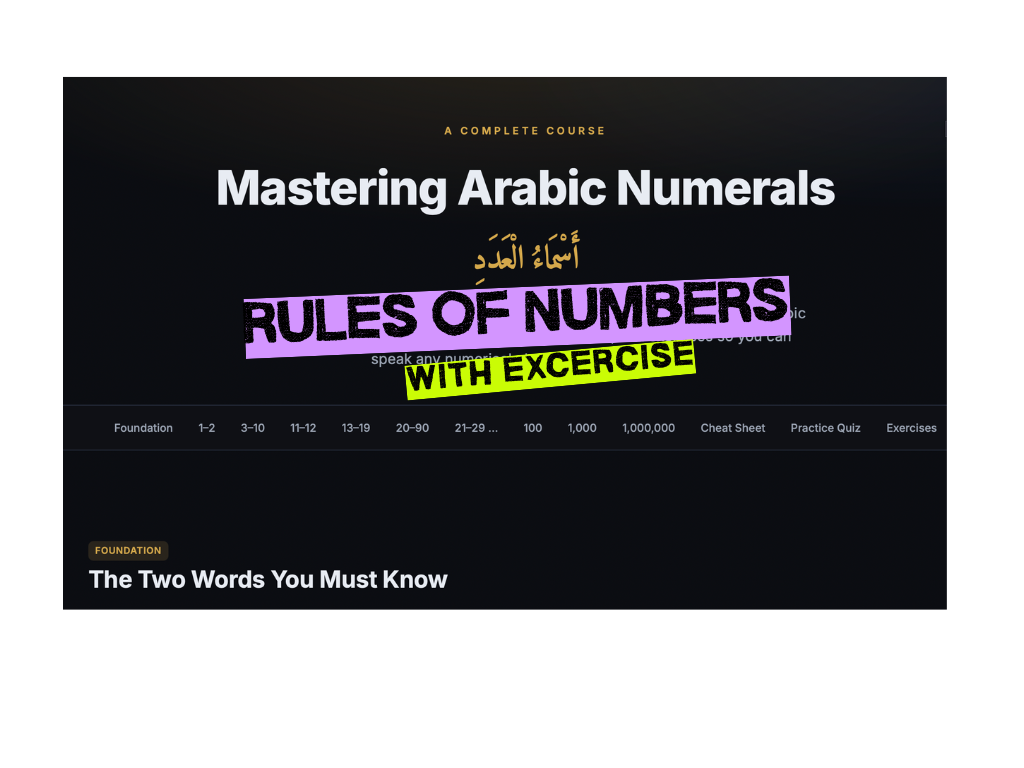
The Rules of Arabic Numbers course from Islam Hashtag is built precisely for intermediate-to-advanced Arabic students who want to close this specific gap rather than start from scratch.
What the course covers:
- The Foundations (1–10): the shift from natural agreement in 1–2 to the reverse-polarity rules governing 3–10, including how to determine a number’s gender from the singular form of a plural genitive noun
- Compounds & Decades (11–99): the alignment rules for 11–12, the split-gender behavior of 13–19, and the fixed singular-accusative pattern required by the decades (20, 30, 40… 90)
- Macro Scalars (100 to 1,000,000+): the distinct grammatical behavior of مِائَة, أَلْف, and مِلْيُون, and how their gender governs the prefix multipliers that precede them
How it’s taught:
- Structured visual breakdowns of each numerical interval, with control constraints and verified target matches laid out clearly
- Interactive gender drills designed to train instant recognition of reverse vs. natural agreement under time pressure
- 12 workbook translation challenges, progressing from simple phrases (“2 schools”) to complex macro-strings (“3,333 roses”), each with full تَشْكِيل and إِعْرَاب verification
This isn’t a beginner’s overview — it’s explicitly designed for intermediate to advanced Arabic students, translation professionals, and grammar enthusiasts who want to eliminate recurring errors and reach genuine technical precision with numbers.
At $9 (reduced from $19), it’s a low-commitment way to close a gap that, left unaddressed, tends to surface repeatedly — in translation work, in teaching, and in everyday spoken Arabic.
Why This Is a Smart Use of Summer Study Time
For Alim and Alimah graduates, summer is often the only stretch of the year without a packed academic schedule. Rather than spreading attention across broad review, a focused course like this lets you walk into the next academic year — or into teaching, translation, or further study — with one less recurring error to second-guess yourself on.
If Arabic numbers have quietly been your exception to an otherwise strong grasp of grammar, this is the kind of course that’s built to fix exactly that, in a format that respects the level you’re already at.
Explore the Rules of Arabic Numbers course –
Try it Now:Arabic number rules self study