
A lesser-known but authentically reported bedtime dua concerns not just the words spoken before sleep, but a specific Sunnah — placing the right hand under the cheek — accompanied by a short supplication recorded in Sunan Abu Dawud.
Arabic:
اللَّهُمَّ قِنِي عَذَابَكَ يَوْمَ تَبْعَثُ عِبَادَكَ
Transliteration: Allāhumma qinī ‘adhābaka yawma tab’athu ‘ibādak.
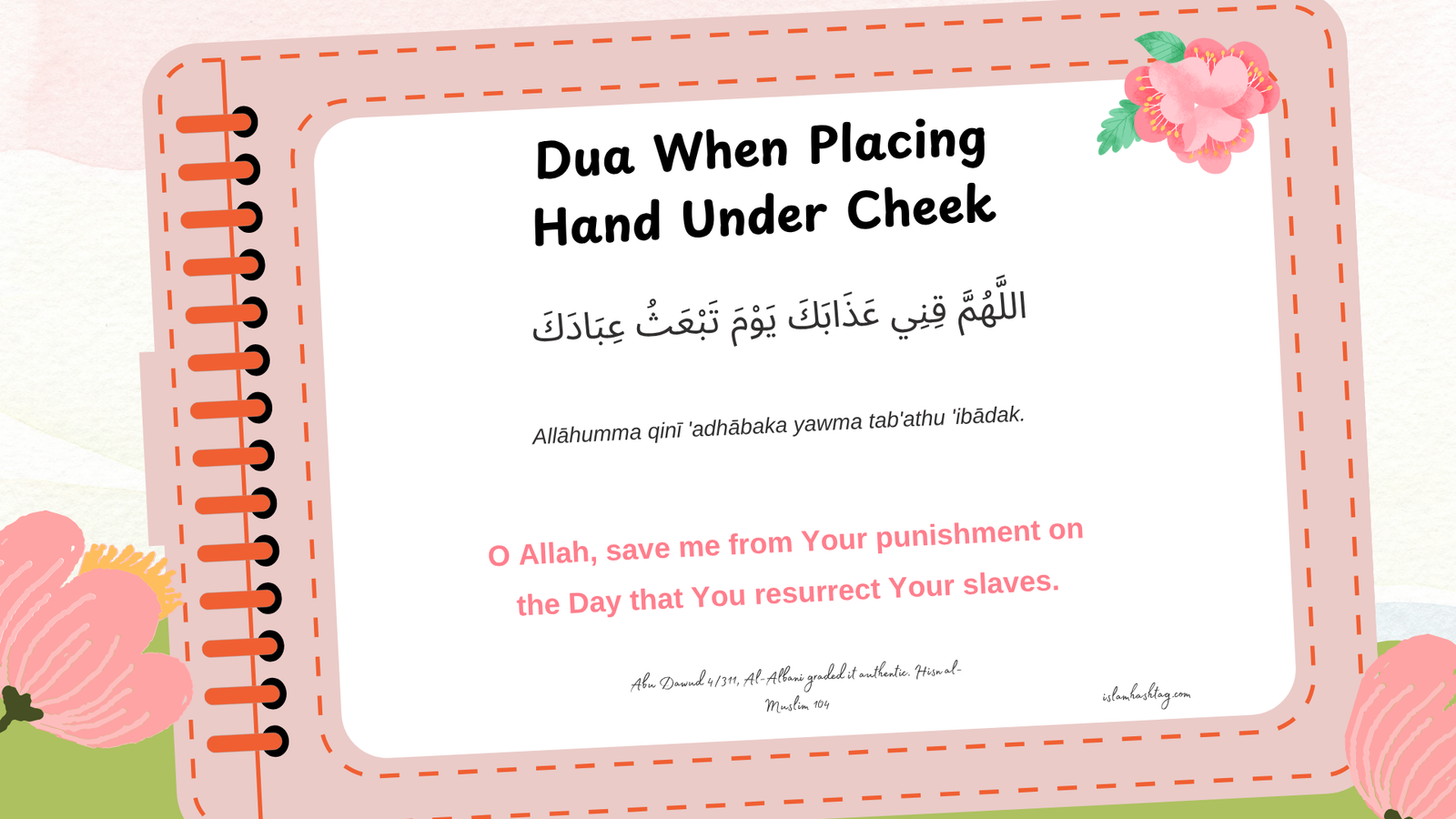
Translation: “O Allah, save me from Your punishment on the Day that You resurrect Your slaves.”
Reference: Sunan Abu Dawud 4/311; graded authentic (sahih) by Shaykh Al-Albani; Hisn al-Muslim 104.
This dua is notably brief compared to the other bedtime supplications, and its content differs in focus: rather than addressing the immediate uncertainty of the night ahead, it looks toward the Day of Judgment. Hadith scholars have observed that this reflects a broader pattern in Prophetic bedtime practice — sleep, as a temporary “minor death,” was treated as a natural occasion to reflect on the final resurrection, without that reflection becoming morbid or anxiety-inducing.
The accompanying physical posture — resting on the right side with the right hand tucked beneath the right cheek — is separately established as Sunnah in other authentic narrations describing how the Prophet ﷺ positioned himself for sleep. Combined, the position and this dua form a complete short practice: an easy addition for anyone who already recites the longer bedtime adhkar (the dua when lying down and the dua before sleep) and wants to close the sequence with something brief but complete in meaning, covering both the night immediately ahead and the Hereafter — a fitting final line before drifting off.