
The first words a Muslim is encouraged to say upon opening their eyes each morning are not a random preference — they are a Sunnah with a clear hadith basis, recorded in the collection of At-Tirmidhi and graded authentic by Shaykh Al-Albani.
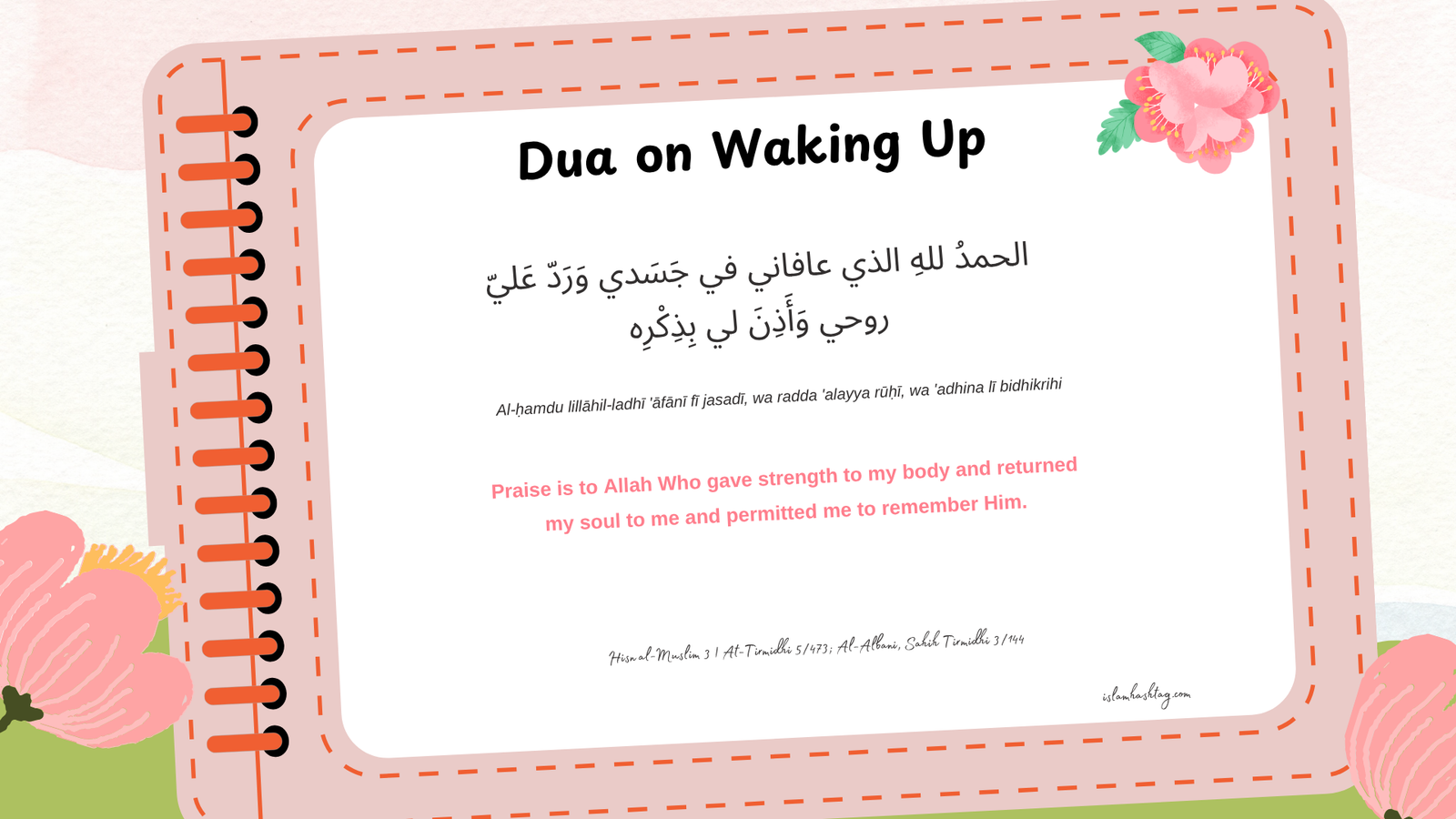
Arabic:
الحمدُ للهِ الذي عافاني في جَسَدي وَرَدّ عَليّ روحي وَأَذِنَ لي بِذِكْرِه
Transliteration: Al-ḥamdu lillāhil-ladhī 'āfānī fī jasadī, wa radda 'alayya rūḥī, wa 'adhina lī bidhikrihi.
Translation: "Praise is to Allah Who gave strength to my body and returned my soul to me and permitted me to remember Him."
Reference: Hisn al-Muslim 3; At-Tirmidhi 5/473; graded authentic by Al-Albani, Sahih Tirmidhi 3/144.
This dua on waking up contains three distinct acknowledgments in a single sentence: gratitude for physical wellness ('āfānī fī jasadī), recognition that sleep is a form of the soul's temporary departure returned each morning (a point tied to Qur'an 39:42, "Allah takes the souls at the time of their death, and those that do not die, during their sleep"), and gratitude for the ability to engage in dhikr — remembrance of Allah ﷻ — for another day.
Reciting it upon waking is a small act with an outsized function: it reframes the very first conscious moment of the day around gratitude rather than routine, before checking a phone or beginning any task. Several scholars of Hadith, including those who compiled Hisn al-Muslim, place this dua alongside the pre-sleep adhkar as a matched pair — one closes the day in Allah's ﷻ protection, the other opens it in His praise.
For those establishing a consistent morning practice, this dua pairs naturally with the broader morning adhkar (adhkar as-sabah), though it holds its own distinct occasion: the moment of waking itself, before anything else is said or done. Memorizing this single line is often the easiest entry point for anyone beginning to build a daily dhikr habit.